The required disclaimer!

This blog is NOT an official Fulbright Program blog. The views expressed are my own and not those of the Fulbright Program, the U.S. Department of State or any of its partner organizations.


Sunday, May 22, 2011

Yes I'm working!

This post is for the friend who after noticing that most of these blog posts document our travels and adventures, all of which sound exotic and exciting, asked "are you getting any work done or doing your Fulbright duty or just having the ultimate sabbatical safari?"

I've had a full teaching load this term at Kigali Health Institute.  Courses are taught as modules and most of the faculty in the department teach 1-2 modules for a total of 10-20 credits.  I was assigned and agreed to teach 3 modules for 23 credits, yes, KHI is getting their Fulbright's worth out of me.
  1. From January until mid-March I taught the Biostatistics module to the 4th year students. 
  2. From mid-February until early April I taught the Clinical Epidemiology module to the 3rd year students.
  3. From April until early May I taught an Orthopaedics I module to the 2nd year students. 
The 2nd year physio students, all students are supposed to come to class in their lab coats
Teaching was a tricky experience.  These students speak fluent Kinyarwanda, in secondary school their instruction was in French and a couple of years ago the language of instruction in secondary and higher education was changed to English.  Now I think I have the easiest accent and many students agreed but it turns out my lecture style and joking manner were quite new to them.  Very few lecturers use active learning techniques as the most common style of conducting a class is the straight lecture.  Often students seemed not know what to make of my methods.  I quickly discovered that the trick to successful teaching was to work with material on Monday, review it on Tuesday and start Wednesday with the same material as on Monday with something new added in.

Students do not have textbooks (faculty don't have many themselves) and they rely on published notes that faculty provide (from what I've seen that faculty plagiarize from elsewhere).  I felt writing a full set of notes was too much pressure since these notes are essentially textbooks themselves and I couldn't write 3 texts while I was here.  Luckily I brought some orthopedics materials to give out to the students and I provided them with the ubiquitous and ugly PowerPoint slide sets that helped me to organize the content.

In between teaching, I have been holding clinic hours Tuesday and Thursday morning at the KHI Kiyovu clinic.  Prior to starting their own clinical experiences, the 4th year students would join me in seeing patients.

As of May all of the students are out on full-time clinical experiences.  These experiences are SO, SO different from our approach to clinical education in the US.  The students go out in groups of usually 6-10 depending on the clinic size.  All the clinics are hospital based since all physio here is hospital based.  The students are assigned patients and it appears to me that they are often seeing these patients with little supervision.  Two days each week a KHI faculty member visits the clinic and the students see patients with the oversight or assistance of a faculty member.  Thus far, I've visited Kigali based clinics including King Faisal Hospital, Kanombe Military Hospital, and the Centre Hospitalier Universitaire de Kigali (CHUK).  There are rumors flying about the future of Kanombe Hospital which is near the airport; for the curious, keep your eyes on the US military Africom which apparently may be a partner in the hospital's renovation.
The ultra-modern King Faisal Hospital which was recently accredited by some international group

The waiting area at Kanombe

The gym at CHUK

In the next two weeks I will be out in the provinces at Gatagara and Gahini.  I'm not so sure how effective my clinical teaching has been, it's pretty clear that the style of orthopaedic treatment in the U.S. is pretty different from the style here.  There is barely any patient documentation written and I've seen loads of use of massage, hot packs, infra-red and a few other modalities that I thought had disappeared with the dinosaurs. 
This set up was done by a student after I explained why modalities would be ineffective in this patient's case

Signage at King Faisal, can you say Physical Therapy?

Signage at CHUK now I'm really confused about how to say this in Kinyarwanda
4th years at King Faisal

In addition to teaching and clinic, I've been working with my Rwandan colleagues to assist them with their scholarly endeavors.  I've worked on a number of different projects including one that will be presented in June at WCPT (I got last author credit).  I'm right now drafting a manuscript for a special issue of  the Journal of Physical Therapy Education about the issues with and potential for further research collaboration between US physios and those in developing countries based on my experiences.  Aside from helping with my colleagues work, be on the lookout for 2 articles in which I am an author in July of this year (Phys Ther and JOSPT).  The finishing work for these articles was completed while I was here.  Oh yes, how could I forget, one last piece of scholarly work...that darned book continues to occupy my time.  J&B, our publisher now has a website for it so I guess it might be published one day this year.

Adventure and work, I think these past few months we've tried to maintain a balance.  If this post sounds like more than a person on sabbatical should be doing...think again...after all, I'm not the chair/program director while here, instead I'm just another faculty member doing her bit and enjoying it too.

Wednesday, May 18, 2011

Making news in Kigali

I've found these news items that seem to include something about me.  Who knows exactly what they are saying, they are all in Kinyarwanda but I believe they are all about my work as an instructor at KHI and my availability for consultation at the KHI clinic in Kiyovu.

KHI physio clinic story this one comes complete with pictures
Another story about my work in the clinic from the newspaper Izuba
Yet another story about my work in the clinic from a press release on TV/radio by ORINFOR
KHI PR  information about me the KHI public relations blog

Enjoy the read!

Friday, May 13, 2011

In which we make an expotition into Uganda and see lions

Last weekend we again hired Jacques, and drove from Kigali north to western Uganda and the Queen Elizabeth National Park.  The border to Uganda is only 1.5 hours from here, we crossed at Gatuna in Rwanda entering into Katuna in Uganda.  The frontier crossing was an adventure in itself.  Jacques had to go into 4 different offices to get approval to bring the car through, the approval comes in the form of a white slip of paper about 1 inch by 1 inch on which someone wrote in hand, "gate pass."  We had to stand in lines to do exit forms for Rwanda and then entry forms for Uganda which included getting photographed and fingerprinted and visa purchase.  There was a mass of people, trucks and buses and seemingly very little organization in the whole operation.  Before we arrived Saadya was wondering how they handle the switch from right hand side driving to left hand side driving and the answer is...with no clear instructions and often with the road being blocked as trucks and cars all try to make the switch in both directions simultaneously.  The entire affair took us about an hour but with visas in hand we headed into Uganda.

The drive was long, we left Kigali around 9:00am and arrived into the outskirts of the park in the early evening as a big storm approached. At the entry to the park we were greeted by some vervet monkeys crossing the road. Further along, we found our first elephants. 
Elephants and yes, a rainbow
Our initial plan had been to camp but with the storm looking menacing we enquired about lodgings at Mweya Safari Lodge, somehow we couldn't fork over the $600 per night for lodging (we are just not that type of safari family) and we made our way to the campsite setting up our tents by the light of the car.   The campsites at the park were not as pretty as at Akagera and we were sad that we couldn't just travel into the park and set up camp anywhere.  Our night's sleep, once again was serenaded by the sounds of hippos, hyenas and this time...lions!

On awakening we noticed the weavers in a bush near our tests and we had our first campsite visitors, marabou and warthogs. 
Weaver with a nest

Good morning warthog, aren't you handsome today
Marabou from the backside at our campsite, from the front you see his black raincoat

Nava describes marabou as looking like guys in black raincoats who seem to be dressed for the wrong party.  From seeing them at the tops of trees and up close, I'm now pretty sure that it is marabou who have the "Whacha wanna do" conversation in the movie Jungle Book and not vultures who appear much, much more intelligent.  After packing up for the day we went to the park office to get our passes and camping permit.  The grounds of the office were right in the wandering path of a group of mongoose who seemed to be hoping for a treat. 
Banded Mongoose

While at the office, I bought Saadya a true safari hat, I think he looks great in it.
Saadya reading at the camp site in his new safari hat
Queen Elizabeth Park (QEP) has an incredible number of birds (more species than in the entire UK I read somewhere) and other animals.  Our list of wildlife spotted increased on this trip and included elephant, banded mongoose, warthog, hippo, Nile crocodile, African buffalo, Ugandan kob, waterbuck, chimpanzees, black and white colobus and vervet monkeys, baron lizard, fruit bat, and many birds like the coucal, palm nut vulture, long crested eagle, fish eagle and Egyptian goose.  The park is bordered to the west by the Rwenzhori Mountains and the Congo which make a beautiful back drop, and look very tempting as a hiking location.  Lake George marks the north of the park and Lake Edward marks the south.  We camped near the Kizinga channel that connects the two lakes.

Our first day we drove off to the track that runs through the crater area.  These craters were formed by volcanic explosions and create a really beautiful landscape. 
Crater in QEP
There is not much wildlife viewing up near the craters but on the way we did have to stop for an elephant Xing.
Elephant crossing
Safari girls
We lunched at the overpriced Mweya Lodge and then, in the afternoon we took the boat ride on the Kizinga channel which offered a different view of animals and many amazing shorebirds. 
Elephants having an afternoon swim

Hippos


We returned to our campsite, as Nava was gathering wood and straw for our fire, we heard a noise and looked up to see an elephant approaching.  Patricia quickly called Nava into the rain shelter and the elephant sauntered through the campsite disturbing only the brush but leaving our tentsite intact.  That night we were awoken by a very loud hyena paying his visit to us, Jacques got up to look at him and told us in the morning that he was not only loud but pretty large.

Our second day of driving was a quest to find some lions.  We had heard that people were seeing a pride not too far from us and drove off hopeful.  After a couple of hours of driving, getting lost and looking we were almost ready to give up.  The park ranger who we asked encouraged us to go to the "mating grounds" where he just saw 9 lions.  We drove up there and noticed quite a bit of freshly killed kob but couldn't find the lions.  We circled the mating grounds 2-3 times, and then, suddenly we spotted them resting under some trees and recovering from their feast.  The kings and queens of the savannah.  Seeing any of these animals in the wild is amazing but seeing a lion in the wild really left me totally awestruck.

Lion, he was panting and exhausted from the hard work of eating his Kob
After two nights in tents, we treated ourselves to an evening at a lodge driving up to the ridge in Kichwimba and staying at the Kingfisher Lodge.  From the lodge we had views of the park and with binoculars could even see herds of elephant. 
View from Kingfisher Lodge
We had dinner at the overlook and enjoyed a relaxing evening.  In the morning, Patricia and Jacques set off to track chimpanzees in the Kyambura Gorge while Nava enjoyed the swimming pool and Saadya and I read. 
Kingfisher Lodge had 3 pools and 2 cool water slides
From Patricia's report, they gorge was also beautiful and really different from any other terrain we saw.  Although many people track and see nothing, they found the chimpanzees and were treated to quite a show including a teenage chimp showing off his swinging abilities.  Doesn't matter your species, teenagers always steal the show. 

In the afternoon we drove back to Kigali knowing that this was probably our last BIG family adventure of the trip, as we now enter the final month of our stay in Rwanda.

Monday, May 9, 2011

100 Days

Mention Rwanda to anyone in the States and the only association they have is of the 1994 Genocide, usually because of viewing the film Hotel Rwanda.  Prior to our departure, when I wanted to read about the country most of the books available were focused on the Genocide.  It is recent history and it has scarred the lives of all who live here.

I've noted more than once that the beginning of April is marked here by Genocide Memorial Day.  In truth it is a period of 100 days of commemoration marking the time from April 6 until July when hundreds of thousands of people were killed.  We were not in Rwanda on April 6 and 7 (many ex-pats leave the country to allow the Rwandans a time to mourn) but these two days are marked by memorial marches and official ceremonies of commemoration.  There is an official commission, the National Commission for the Fight Against Genocide on which you can read more detail about how the 17th commemoration is being marked. 

I could never do justice to writing about the Genocide, I won't even try.  Here in Kigali we are surrounded by the survivors, the criminals and many returned refugees.  Most Rwandans keep their stories to themselves.  Every adjective you are thinking right now is appropriate to describe this event. 

During early April, Patricia and I did visit the Kigali Genocide Memorial Centre.  The centre has exhibits that describe the genocide and the history that led to it, exhibits on other genocides and it is also a mass burial site that is still active as even today and this month more bodies of victims are being found.
The memorial flame at the centre, it is lit on April 6 and stays lit for 100 days

One of the areas of the mass graves

Friday, April 29, 2011

Why is this night different?

We returned from our sunny, care-free (well, somewhat) beach vacation in Zanzibar to the spring holiday season (Passover and Easter) and to a country in the middle of the annual mourning period commemorating the Genocide.

There were rumors floating around Kigali that a Chabad Rabbi would be arriving with Matzah and Kosher wine to conduct a seder.  With only two days to go before Passover, it was finally confirmed that his trip was cancelled and we were on our own to figure out the matzah and seder.  I made a couple of fruitless attempts to contact the Rabbi in Kinshasa (Chabad of Central Africa) to see if he would be our supplier before we decided to just go ahead and make our own.  I posted on the local ex-pat list-serve inviting anyone interested to our seder and a few other seder invitations were posted by others as well.  Nava, Saadya and I spent Sunday afternoon making matzah.  As Nava rolled out here first matzah I noticed the shape quite by accident looked oddly familiar and...voila, we had out African Matzah in the shape of Africa!
Matzah by Nava
On Monday evening we sat down to our seder with two guests, Yaron, an Israeli who is an agricultural specialist here on a private contract working on a project to try to grow wheat and Wendy, an American who is here with "Save the Children" on a 6 month contract. Our seder table was beautifully set with kanga tablecloth from Zanzibar and a mouthwatering charoset that Patricia concocted from native produce (macadamia nuts, cashews, mango, apple and grape juice). There were a few items we couldn't find so we improvised a shank bone and maror.  Saadya led the seder and did a great job.  Nava was sad to find herself once again the youngest but managed the four questions without the benefit of LGA classroom practice.  I had one paper copy of a Haggadah and some pdf files so you'll notice a computer on our table.
Looks like a seder table doesn't it?

Saadya led

Our seder
Our seder disasters were minimal, nobody spilled wine on a white tablecoth and there were no matzah balls to sink to the bottom of our stomachs.   I did make a terrible pilau rice and have now been banned from all future rice making activities.  Funnier than my rice, Yaron wanted to bring some mixed fruit for dessert but when we opened the can it turned out he had bought an industrial sized batch of mixed tropical fruit jam.  Yep, this night was same, different, same.

Friday of that same week was a day-off as Good Friday is a national holiday in Rwanda.  Nava and Patricia went to a Antja, Rob and Yana's house to color eggs.  Antja and Rob are German and British respectively and are here as architects working on a library project, they arrived in Kigali at about the same time as us, coming from 11 years in Uganda.  Their daughter Yana is in 2nd grade at ISK where Nava goes to school.  We had to work very hard to get eggs that are whitish to take on the color since most eggs here are brown (with white yolks!) and I thought to buy food coloring from one of the Indian stores where I got a vivid red, green and yellow. 
Dyed eggs in a Rwandan basket
Then on Sunday we joined this family and a couple of others for a brunch and egg hunt at their house.
Nava on the hunt for chocolate
The brunch was great, good food, nice social atmosphere and plenty of playmates.  The big added bonus is that the yard at Antja's house has some trees that are producing piles of avocado, guava and pomegrantes as long as the local vervet monkeys stay away.  Nava came home with both a bag of chocolate and a bag of avocadoes, Saadya, Patricia and I came home with full tummies and the good feeling of having some social ties.

Wednesday, April 20, 2011

Jambo, Pole-pole, Karibu (yes, that's nearly our full Kiswahili lexicon)

As I was getting ready to write another posting I was thinking that those of you reading this are probably thinking that all we do is travel around East Africa, take holidays and go on adventures.  This posting will reinforce that belief as we are just returned from a 9 day holiday in Zanzibar, but be forewarned, I promise a very dull posting quite soon about the ways in which we spend most of our days in Kigali (sleep, eat, work, go to school).  Meanwhile, twende - let's go, I've got stories and over 300 photos to share!

About a month ago we decided to use the two week spring vacation period from Saadya and Nava's school to travel to a beach destination in East Africa.  We debated the possibilities...Madagascar, Mombasa,  Zanzibar...the costs, the multiple interests and decided to land in Zanzibar.  Within a week we got just the right set of flights, the right lodgings, a Tanzanian visa and everything seemed to be smooth sailing.  Then about a week before departure we started to get daily notices that our flights were being rearranged by an hour or two first forward in time then backward.  Finally, the day before we were set to leave we were notified that our flight had been cancelled but we could be rerouted and would leave at - ouch, 3:00am (in essence gaining a day in Zanzibar).  All of these flight changes gave us some worry about how travelling via Kenya Airways would be but we arrived timely though tired.  In fact, the U.S. airlines could learn a thing or two from Kenya Airways.  On our first flight from Kigali to Nairobi, since everyone was checked in, we left 1/2 hour early and on both of our flights we were served a small meal even though the flying time was no more than 1-1.5 hours; I'll never settle for a soda and a bag of nuts again!  For Saadya, the trip offered the thrill of flying on 3 new airlines, Kenya Airways, Precision Air and Rwandair.
Yep, here he is, the pride of Africa on his way from Nairobi to Zanzibar
On getting off the plane we were immediately hit by the fact that we had entered a tropical climate.  The long pants and sweaters we needed on leaving Kigali were about to be packed away for 9 days of heat, humidity and a bit of tropical rain.  Our first big schvitz occurred while waiting to get through the visa/immigration line, not because we were nervous about the experience but because it was hot and slow, slow, slow.  Having the visa in advance was not really helpful as we still needed to go through the form filling out, questioning, and fingerprinting process that marks both the entry and exit from Tanzania.  Once out of the airport we were met by an arranged driver and whisked away to our first destination Mbweni Ruins Hotel.  The hotel sits just south of Stonetown and incorporates the ruins of a school built in the late 1800's for freed slaves.
Ruins at Mbweni

Old Chapel from the ruins at Mbweni
The hotel also has a long pier that Saadya liked to sit on and read, a beautiful beach and a very nice pool for Nava and kayaks to explore the Mangroves. 

View of the hotel from the end of the pier

Our first sunset at Mbweni
The location was perfect for our first explorations which included a trip to a spice farm, exploring Stonetown, and a trip to Jozani forest.

The spice farm trip happened on our first full day over the course of a rainy morning.  The rain did not surprise us, April is the beginning of the rainy season in Zanzibar.  The benefit of rainy season travel is that there are fewer tourists and prices for many places are lower.  We hired a driver and ventured off to see how and where spices are grown on "The Spice Islands."  The tour was great fun, our guide on the farm played a typical tourist game with us giving us hints as we moved from plant to plant or tree to tree so that we could guess what was in front of us.  We saw, tasted and smelled nutmeg tree, cardomom, clove, ylang-ylang, peppercorn, vanilla, jackfruit, grapefruit, pineapple, cassava, cinnamon, starfruit and coconut as we wandered through the maze of palms, bushes and trees.  Each of us was given a banana leaf cone to fill with treasures during our walk.  The tour ended with one of the guides climbing a coconut tree and picking fresh coconut from which we drank the juice.
Nutmeg

Vanilla bean
Nava collecting spices

King of the spice tour

The coconut tree climber

Drinking fresh coconut juice
On our way back to Mbweni we stopped at the nearby Kidichi Persian Baths.  The baths are a beutiful building that were constructed by Sultan Seyyid in about 1850 for one of his wives.  During our 9 days in Zanzibar we made an effort to learn a bit of history.  Its a complicated and fascinating history involving trade routes, slave trade and migrations of people to the islands from Portugal, Oman, Persia and the UK.  We paid the caretaker to see the inside and were dismayed to see and hear about how the Tanzanian government, in an effort to make care easier, had whitewashed the building so the coloful Persian designs were gone and the stained glass from the ceiling was removed.
Kidichi
As we drove back to Mbweni our stomachs started making the I'm hungry sounds so our driver took us to a popular local eatery called Laakman's for our first taste of Zanzibar/Swahili food.  I immediately fell in love with the pilau rice and on a later day found the delight of the spice rice.  If I can learn to cook rice properly I now know which spices belong in it.

The following day we explored Stonetown, the large city of the main island of Unguja.  In Stonetown we saw so many other Muzungu tourists that it was hard to believe we were there in the off season.  Saadya was excited to tour the city since, as he often pointed out, it is a World Heritage Site.  We visited all the typical tourist sites learning some important history and seeing the amazing mix of city market area, narrow alleys, mosques and architecture that is part Moorish, part Persian and part Indian. 

Fish Market

Bananas in the market

Spices for sale


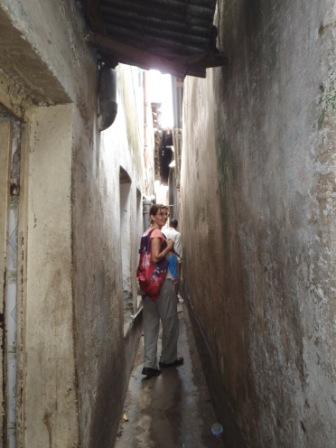
A Stonetown alley
We managed to avoid Freddy Mercury's house (yep, he was originally from Stonetown) and ended our day at the Mtoni palace ruins which was the palace  of Sultan Said where Princess Salme was born.  Your very own brief history of Zanzibar (and a recipe for Pilau Rice) can be found at ZanzibarNet.  While we were travelling in Zanzibar, Patricia bought a copy of Memoirs of an Arabian Princess in its original German, read it and filled us in on much of the history.

As wonderful and exotic as Zanzibar, Stonetown and our travels were, we also got some insight into the politics and issues that boil underneath the whitewash that is presented to tourists.  Our drivers told us of the problems of corruption and bribery, the government that makes promises but doesn't come through.  We saw the poverty and the effects of the high rates of unemployment.  We saw trash everywhere as the island has no sustainable approach to dealing with waste disposal.  The 3 hotels/resorts at which we stayed were all owned by Europeans so although we were contributing to the island economy much of our money was making its way back to the western world (except at Chumbe).  At our last hotel, Patricia and I explored by bike the neighboring towns and saw the poor living conditions that those who stay behind the resort walls never see.  In sum, like in most "fabulous" resort locations, the locals are not enjoying the sun, fun and food that we can afford.  This tainted but did not ruin our vacation, better to know and see than to ignore.

Our final day at Mbweni we took a trip to Jozani Forest where we walked through a beautiful lush forest, a boardwalk through a mangrove swamp and visited with the Red Colubus Monkeys.
Red Colubus

Our forest walk
The next morning we awoke and took a ferry for a two night stay at Chumbe Island.  I can't even begin to describe how special the stay on the island was.  Chumbe Island is a privately owned and protected reef sanctuary and forest preserve.  The island is a true eco-tourism site creating a minimal footprint, providing important edcational programming, conducting marine research and protecting the preserve.  We felt as if we were treated like royalty.  Two days of snorkeling, beach and forest exploration, amazing accomodations and gourmet food served always near the beach or in the evening, by candlelight on the beach.  On our first day, within hours of arriving, all 4 of us were taken out snorkeling on the coral reef sanctuary.  Our guide taught us what we needed to know, helped Nava and Saadya and we were off into the amazing watery wonders swimming with beautiful fish (yes, even Nemo was there) and even seeing and swimming with sea turtles.  By the second day, Nava was off and snorkeling on here own (Saadya got sick and had to skip day 2) and identifying the tropical fish as she went along.  If you ever find yourself thinking about a trip to Zanzibar Chumbe Island is a MUST VISIT site.
Chumbe as we approached from the boat

Our bungalows

First floor of one of the bungalows, sleeping quarters were up the ladder

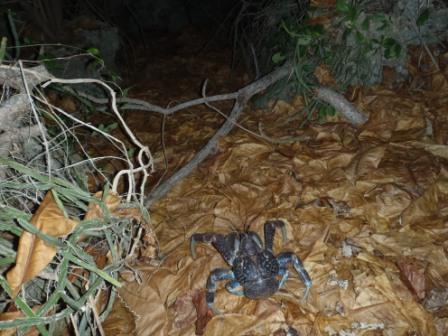
Coconut crab (they only come out at night)

Nava with a fossilized giant clam

Exploring the Chumbe beach
As sorry as we were to leave Chumbe, we were certainly feeling relaxed and begining to get our tans on.

Tanned and relaxed!
Next stop, Pongwe Beach Hotel, a resort renowned for its beautiful beach and infnity pool.  Our goal at Pongwe was to spend our last 3 days roaming the beach and not really going anywhere.  GOOD NEWS, we accomplished this very difficult goal finding it nowhere nearly as difficult as it may sound to you.  Nava spent three days clad only in a bathing suit, creating shell gardens and swimming.  Saadya relaxed and continued to recuperate from his bout of Zanzibaritis.  Patricia and I ventured out on bicycles to see a bit of the surrounding area.  Nava, Patricia and I tried our hands at kayaking. We all walked up and down the beach, hung out at the pool and continued to feast on seafood.  The photos capture some of our Pongwe time but none of the amazing turqoise, purple and blue colors of ocean.

Sunrise walk

Kayaking

More kayaking

Our Zanzibari Bed

Our seashell garden

Nava on the beach wrapped in a Kanga


The view toward the beach at Pongwe
Our exotic Zanzibar journey came to a close with a quick flight from Zanzibar to Dar and another round of fingerprinting as we left Tanzania arriving back to the cool air, the clean streets and the now familiar sights and sounds of Kigali, the place we are currently calling home.